
Tag: Thomann

  • Fender sues Thomann over Stratocaster body shape copyright

    Fender sues Thomann over Stratocaster body shape copyright

    For the full background on the Fender shape dispute, including the dated timeline and the legal questions, see our reference article, Fender, Thomann, and the Stratocaster shape dispute.

    The Stratocaster shape dispute has reached the stage the whole story has been building toward. Fender has filed a copyright infringement action against Thomann in the Regional Court of Düsseldorf, as reported by Reuters on 16 July, in response to the lawsuit Thomann brought in June. The validity of Fender’s claimed copyright and whether the challenged Harley Benton designs infringe it are now before a court with fully resourced parties on each side. That creates the first publicly identified, fully resourced vehicle for the contested test the dispute has lacked from the start.

    What has happened

    Fender’s filing, made this week in Düsseldorf, alleges that Harley Benton-brand guitars developed and sold by Thomann copy the Stratocaster shape. In a statement, Fender described the action as “the expected next step in the legal process”, framing it as the procedural consequence of the case Thomann started. Fender’s statement also argues that Thomann is no small independent builder but one of the world’s largest instrument retailers, one of Fender’s own largest retail partners, and the owner of Harley Benton, one of Europe’s largest guitar brands. The statement also discloses that Fender’s engagement after the Düsseldorf ruling extended to online marketplaces across Europe, alongside manufacturers, distributors, and retailers, and says that in many instances companies have chosen collaborative solutions, including design modifications.

    Reuters’ report and Fender’s statement also identify, for the first time in the public record, the legal vehicle used by Thomann in June. It is described as a Declaration of Non-Infringement. Reuters reports that Thomann disputes the validity of Fender’s claimed copyright, arguing in part that it rests on a default judgment that was never tested against a defence, while Fender says Thomann is seeking a determination that it may continue selling the challenged Harley Benton designs. Until now, the legal form of Thomann’s action had not been publicly identified.

    Reuters’ account of the filing carries market figures the dispute has not had before. Fender says it sells about 500,000 Stratocasters a year, with around 34,000 of those sold in Germany, and cites Thomann’s own estimate that the retailer sells roughly 10,000 Fender Stratocasters a year.

    The sequence, stated fairly

    In June, Fender’s chief executive said the company was not suing anyone at that time and preferred practical solutions. Days later, Thomann filed its declaration action. Fender now characterises its infringement filing as a response to proceedings Thomann began, and its statement says the company’s preference was dialogue rather than litigation. Read in sequence, both positions can be accurate. Fender did not bring the first court action between the parties, and it has now filed an infringement action of its own. Thomann, for its part, framed its filing as standing in for manufacturers and dealers without the resources to defend themselves, and has urged Fender to withdraw the cease and desist campaign and return to a cooperative relationship. Readers can weigh the framings. The filings are what now matter.

    Why this changes the dispute

    Every stage of this story until now has rested on a claim considered only on an uncontested record. The Düsseldorf default judgment of 22 December 2025 was entered against a seller who never appeared. The cease and desist campaign was built on that record, and the central question our reference article has tracked from the start is how the copyright claim fares against an opponent who contests it. That question now has a vehicle. An infringement action and a declaration of non-infringement concerning the same claimed shape are now before the court, creating the first opportunity for both sides to present evidence and argument on a contested record.

    Any substantive outcome will matter far beyond the two parties. A ruling that the Stratocaster shape is protected and that the challenged Harley Benton designs infringe would strengthen Fender’s position across the European market. A ruling that the shape does not clear the copyright threshold would undercut the foundation of the letter campaign. A narrower ruling that particular Harley Benton designs do not infringe could weaken Fender’s wider position, though its effect on other recipients would depend on the court’s reasoning and the designs concerned. If the proceedings reach a judgment on the merits, the core copyright questions would, for the first time, be considered on a contested record rather than through a default judgment.

    What is and is not known

    Confirmed, per Reuters and the parties’ statements, Fender has filed an infringement action against Thomann in Düsseldorf, Thomann’s June action has been identified as a Declaration of Non-Infringement, and the market figures above come from Fender’s filing as reported. No case numbers have been made public, and it is not known which Harley Benton models are at issue, what specific relief Fender seeks beyond the infringement allegation, whether the two actions will be joined, when any hearing might take place, or how long a contested proceeding of this kind will take. Neither pleading has been made publicly available in the sources we have reviewed, so accounts of the filings currently rest on the parties’ statements and press reporting. Much of the procedure will unfold through written submissions, so public developments may continue to arrive intermittently.

    Where it goes next

    Further responses, any consolidation of the actions, and other procedural steps are likely to unfold over months, although no public timetable or hearing date is currently available. Settlement remains possible at any point, and both companies’ statements leave room for it, Fender’s by stressing dialogue, Thomann’s by urging a return to cooperation. If the case runs to judgment on the merits, it could produce the first publicly identified contested ruling in this campaign on whether the Stratocaster body shape is Fender’s protected work. We will keep our reference article updated at each step.

    Disclosure: Vintage & Rare operates an online marketplace for vintage, boutique, and rare instruments, including sales into Europe. Vintage & Rare has not been contacted in connection with this campaign.


    Sources and further reading

    News reporting: Reuters’ report of 16 July 2026 on Fender’s filing against Thomann.

    Company statements: Fender’s full statement, as published by Guitar World on 17 July 2026, and Thomann’s June 2026 statement on its legal action.

    Primary court record, background: Regional Court of Düsseldorf, default judgment of 22 December 2025, case 14c O 64/25.

    Vintage & Rare coverage:

    Fender, Thomann, and the Stratocaster shape dispute: the full timeline and legal questions (our reference article, updated as the case develops)

    Fender’s body shape campaign reaches Yamaha, the largest recipient yet

    Fender’s letter to an Australian vintage dealer is about listing language, not selling used Fenders (the separate trademark matter)

    Thomann takes legal action against Fender over the Stratocaster body shape

    When a shape becomes a battleground: Fender, the S-style, and what it means for the builders we love

  • Fender, Thomann, and the Stratocaster shape dispute: the full timeline and legal questions

    One-sentence answer: Fender holds a German default judgment supporting its copyright claim in the Stratocaster body shape, but the ruling was uncontested, and with Thomann’s Declaration of Non-Infringement and Fender’s answering infringement action both now before the Düsseldorf court, the claim is heading toward its first contested test.

    The Fender Stratocaster body-shape dispute is a copyright dispute with market-access implications. The question at its centre is whether Fender can use a December 2025 German court ruling, and the copyright claim behind it, to restrict new S-style guitars. The ruling itself is a German judgment, and Fender’s public position extends the claim to products made, marketed, sold, or distributed into the wider European Union. The dispute began with a default judgment in Düsseldorf, escalated through cease and desist letters to builders and retailers in 2026, and entered a new phase when Thomann announced legal action against Fender.

    This reference article explains the dispute in one place: what the Düsseldorf court decided, what it did not decide, why the 2009 United States trademark case still matters, how Fender and Thomann frame the issue, which companies have publicly been drawn in, and what remains unresolved.

    Vintage & Rare is not a party to the case. This article serves as a reference for dealers, builders, collectors, and serious players on the legal and market implications of the S-style dispute. It is not legal advice.

    Status, as of 14 August 2026: Both parties are in court. Thomann filed a Declaration of Non-Infringement in June, and Fender answered on 16 July with a copyright infringement action against Thomann in the Regional Court of Düsseldorf. No hearing date has been made public, no defence has been reported as filed, and no decision has been made on whether the two actions will be joined. Separately, Yamaha, the world’s largest instrument maker, confirmed in July that it received a Fender notice letter in May and is reviewing how to respond, making it the largest confirmed recipient by corporate scale. No further recipients have been publicly confirmed since.

    New since July: the first visible product response. On 12 August 2026, LsL Instruments, a confirmed recipient, showed a reshaped Saticoy 24 with the body geometry changed. LsL has not said the redesign was made for legal reasons. Separately, the response letter written for one recipient has been published, and it asks Fender to state which specific design elements it claims are protected.

    Separate matter, July 2026: An Australian vintage and used guitar store has publicly confirmed receiving a cease and desist letter concerning Fender’s trademarks. That matter is reported to concern the use of Fender model names in listings for non-Fender instruments. It is a trademark matter and a separate legal track from the body shape copyright claim covered on this page. Our full report is here.

    The short version

    Fender obtained a default judgment from the Regional Court of Düsseldorf on 22 December 2025, case 14c O 64/25, against a China-based seller that offered near-identical Stratocaster-style copies for sale in Germany via AliExpress.

    In that default judgment, entered on Fender’s pleaded facts after the defendant failed to appear, the Düsseldorf court treated the Stratocaster body shape as a copyright-protected work of applied art under German law applying European principles. Because the claim was not tested against a defence, it was decided on an uncontested record.

    According to company statements and trade reporting, Fender then relied on the ruling as the basis for cease and desist letters to builders, distributors, and retailers of S-style guitars.

    Fender says the campaign is aimed at close copies and at products made, marketed, or sold in the European Union, not at vintage Fender instruments, collectors, artists, or all double-cutaway guitars.

    Publicly confirmed or reported affected names include Harley Benton, LsL Instruments, PRS, and Yamaha, which confirmed in July that it received a notice letter in May.

    Thomann filed a Declaration of Non-Infringement against Fender in June, asking the court to declare that the S-style body shape does not infringe, and on 16 July Fender answered with a copyright infringement action against Thomann in the Regional Court of Düsseldorf. Both sides of the question are now before a court.

    In August, the dispute produced its first visible product answer. LsL Instruments showed a reshaped S-style with changed body geometry, without saying the change was made for legal reasons. A commercial response is not a legal answer, but it is the first indication of what compliance might look like in practice.

    The central legal question is not whether the Stratocaster is famous or historically important. The question is whether the specific body shape qualifies as protected creative expression under German and EU copyright law, or whether its relevant features are too functional, too conventional, or too broadly adopted as general S-style design language. In the United States trademark context, a closely related question has been argued on the basis of genericness, which is a different test from the German copyright originality test.

    Key facts at a glance

    Fender Stratocaster body-shape dispute, status as of 14 August 2026.

    FactStatusSource type
    Düsseldorf default judgment of 22 December 2025, case 14c O 64/25, treating the Stratocaster body as a protected work of applied artConfirmedPrimary court record, legal commentary
    The judgment was a default judgment; the defendant did not appear and Fender’s pleaded facts were deemed admittedConfirmedPrimary court record, legal commentary
    The judgment carries a full statement of facts and roughly forty paragraphs of reasoning, applying the CJEU’s December 2025 Mio and konektra decisionsConfirmedPrimary court record
    The defendant was a China-based AliExpress seller of near-identical copies offered into GermanyConfirmed; named in the judgment as Yiwu Philharmonic Musical Instruments Co., Ltd in the version published with an English translation, anonymised in the court-database versionPrimary court record, company statement
    The €250,000 figure is a per-breach coercive-fine ceiling on the named defendant, not damages and not a fine on the wider industryConfirmedPrimary court record, trade reporting
    Fender’s cease and desist campaign is publicly tied to the Düsseldorf rulingCompany-stated and reportedCompany statements, trade reporting
    Harley Benton, PRS, and LsL Instruments are publicly affectedPublicly confirmed, company-stated, or reported, depending on the nameCompany statements, trade reporting
    Thomann has announced legal action against FenderConfirmedCompany statement
    Thomann’s public framing: court resolution of the copyright question rather than a damages claimConfirmed as a Declaration of Non-InfringementCompany statement, news reporting
    The exact court, filing, and docket for Thomann’s actionNot yet publicNone available
    Hearing date, defence filing, or consolidation of the two actionsNot yet public as of 14 August 2026None available
    Whether the German copyright claim survives a contested challengeUnresolvedNone available
    Yamaha received a Fender notice letter in May 2026, confirmed by Yamaha to Reuters in July; models not specifiedConfirmedCompany statement, news reporting
    Fender’s filing states it sells about 500,000 Stratocasters a year, around 34,000 in Germany, and cites Thomann’s estimate of roughly 10,000 Fender Stratocasters sold annuallyReported from the filingReported from the filing
    LsL Instruments showed a reshaped Saticoy 24 on 12 August 2026, the first S-style from a named recipient with visibly changed geometryReported; LsL has not stated a legal motive, and reporting says there was no contact with Fender during developmentTrade reporting

    What is the Fender Stratocaster shape dispute?

    The Fender Stratocaster shape dispute concerns whether Fender can enforce copyright in the Stratocaster body shape against new guitars with S-style bodies sold into Germany or the wider European Union.

    Fender’s position is that the Stratocaster body is an original creative design, first introduced in 1954, and that close copies exploit a design Fender originated. Fender has relied on the December 2025 Düsseldorf default judgment as support for that position.

    The opposing position, advanced by affected builders and now by Thomann, is that the S-style body shape has become a general design language after decades of widespread use. On that view, the double cutaways, body contours, upper horn, and general proportions are functional, conventional, or widely adopted features that should remain available to electric guitar makers.

    The dispute matters because the S-style is not a fringe design. It is one of the central body families in the electric-guitar world. A broad enforceable right could affect builders, distributors, dealers, retailers, and the documentation expected for modern S-style instruments. A narrow or rejected claim would leave the S-style category roughly where the market has treated it for decades, as a widely used design language with many legitimate interpretations.

    Timeline: how the dispute reached this point

    Interactive timeline

    The Stratocaster’s legal status, 2009 to 2026

    How a body shape ruled too generic to trademark in the United States came to be treated as protected applied art under German copyright law. Filter the timeline by legal track.

    A Vintage & Rare reference. Updated 14 August 2026. Not legal advice.

    1. 2009

      US trademark

      US trademark applications refused

      The United States Trademark Trial and Appeal Board refuses Fender’s applications to register the Stratocaster, Telecaster, and Precision Bass body outlines as trademarks, finding the shapes generic and, in the alternative, not proven to have acquired distinctiveness. The applications were opposed by a group of other manufacturers.

    2. 22 December 2025

      German copyright

      Düsseldorf default judgment

      A regional court in Düsseldorf enters a default judgment for Fender against a China-based seller offering near-identical Stratocaster copies into Germany through AliExpress. On the uncontested record, the court treats the body shape as a copyright-protected work of applied art, as far as is known the first German court to apply recent European principles to a case of this kind.

      Legal note

      A default judgment is entered when the defendant does not appear. Fender’s pleaded facts were deemed admitted, so the claim was never tested against a defence.

      It is worth being precise about what that does and does not mean, because both overstatements are in circulation. The judgment is not a bare order. It carries a full statement of facts and roughly forty paragraphs of reasoning, holding the body to be a protected work of applied art under section 2(1) no. 4 of the German Copyright Act, working through the 1907 Art Copyright Act as the law in force when the design was created, the 1892 copyright treaty between Germany and the United States, and the Court of Justice of the European Union’s December 2025 decisions in Mio (C-580/23) and konektra (C-795/23). What it lacks is not reasons. It is an opponent. Authorship, the chain of title, and the specific design elements said to found protectability were all taken as admitted because nobody appeared to dispute them.

      Two versions of the judgment are publicly available. The North Rhine-Westphalia court database publishes it with the parties anonymised and the model redacted. A fully named copy, with a complete English translation, is hosted by the Institute for Information, Telecommunications and Media Law at the University of Münster. That version names the defendant as Yiwu Philharmonic Musical Instruments Co., Ltd, and identifies the listing as an “IRIN 22 Bünde ST E-Gitarre” sold through the AliExpress storefront SHUFFLE Musical Instruments Store. It is a copy of a primary document hosted by an academic institute, not a government publication.

    3. March 2026

      German copyright

      The copyright route goes public

      Fender and its representatives present the ruling as significant for protecting the Stratocaster shape in Germany and the European Union. The basis is copyright in a work of applied art, not the trademark right that failed in 2009. Some later reporting dates the ruling itself to March; that is when it became publicly known, not when it was decided.

    4. May 2026

      Industry dispute

      Cease and desist letters

      Letters reach makers and retailers of S-style guitars. Reporting describes them as asking recipients to stop European sales and to share sales and marketing information, with a compliance deadline reported for late May.

    5. May to June 2026

      Industry dispute

      Builders are named

      PRS confirms it received a letter about the Silver Sky and says it disagrees. LsL Instruments is among the publicly discussed recipients, with Ronald Bienstock, who led the 2009 opposition, reported as acting for at least one party.

    6. June 2026

      Industry dispute

      Fender narrows the message

      Fender’s chief executive says the company is not suing anyone, is contacting a small number of makers whose products come very close to the Stratocaster, and prefers design changes and sell-through periods to financial demands or destroyed stock.

    7. June 2026

      Industry dispute

      Thomann takes legal action

      Thomann announces legal action, says its Harley Benton brand is affected, and frames the move as seeking a ruling that an S-style body shape does not infringe, rather than a damages claim. The exact court and filing are not yet public.

    8. June 2026

      Industry dispute

      The pleaded case is challenged

      In a response letter dated 16 June and posted publicly on 17 July, Ronald Bienstock argues the Düsseldorf ruling rests on a misrepresentation of the Stratocaster’s history: that Fender credited the design to Leo Fender alone while its own materials also credit Rex Gallion and Freddy Tavares, and that the adverse 2009 United States decision was not put before the German court. The same letter asks Fender to state which specific design elements it claims are protected. These are arguments made in correspondence, not findings.

    9. July 2026

      Industry dispute

      Yamaha’s receipt becomes public

      Reuters reports that Yamaha received a Fender notice letter in May. Yamaha, the world’s biggest maker of musical instruments, confirms that it is reviewing the notice and weighing how to respond, without specifying which models are named. Yamaha’s Pacifica, launched in 1990, is the company’s closest S-style design. This is the first confirmed recipient of Yamaha’s overall corporate scale.

    10. 16 July 2026

      Industry dispute

      Fender sues Thomann

      Fender files a copyright infringement action against Thomann in the Regional Court of Düsseldorf, answering Thomann’s June action, now identified as a Declaration of Non-Infringement. Fender’s statement calls the filing the expected next step in the legal process and discloses that its post-ruling engagement extended to online marketplaces across Europe. Both sides of the copyright question are now before the court.

    11. 12 August 2026

      Industry dispute

      The first redesigned S-style appears

      LsL Instruments shows a reshaped Saticoy 24: a smaller body, flatter top, deepened belly contour, narrower and more stooped cutaways, a pointed lower horn on the pickguard, and a more radical hand contour. It is the first S-style from a named recipient to reach the public with the geometry visibly changed.

      What is and is not established

      LsL has not said the redesign was made for legal reasons, and reporting states the company had no contact with Fender while developing it. The connection between the letters and the reshaping is the trade press’s reading, not the builder’s claim. The Saticoy 24 name and the 24-fret configuration also predate the dispute; what is new is the body geometry carried under an existing model name.

    As of 14 August 2026, Thomann’s Declaration of Non-Infringement and Fender’s answering infringement action are both before the Düsseldorf court. No hearing date has been made public, and no defence has been reported as filed. The central question, whether the copyright claim survives a contested test with both sides heard, now has a vehicle, and remains unresolved. What has begun to move in the meantime is the product response, which is a commercial answer to a legal question rather than an answer to it.

    Vintage & Rare Updated 14 August 2026 · Not legal advice

    What did the Düsseldorf court actually decide?

    The Düsseldorf court decided, in a default judgment, that Fender was entitled to relief against the named defendant based on the pleaded facts before the court.

    On the uncontested record, the court treated the Stratocaster body shape as capable of copyright protection as a work of applied art, finding that the specific body form reflected creative choices rather than mere technical necessity, and it granted injunctive relief against the defendant’s distribution of near-identical guitars into Germany. According to legal commentary on the decision, the court applied recent European Court of Justice principles on when a useful object qualifies as a protected work and was, as far as is known, the first German court to apply them to a case of this kind.

    The comparison the court drew is more specific than the phrase body shape suggests. In the commentary available, the court found that the copy reproduced the body’s shape, the shape and attachment of the pickguard, and the position of the cable outlet, not only in proportion but also with close-to-exact dimensions, including the flattening at the rear. The absence of the Fender name on the pickguard and the different colour were held to be irrelevant, because copyright protects the design rather than the brand.

    The defendant did not appear and did not present arguments. That matters. A default judgment can be enforceable and legally significant, but it is not the same as a claim tested through opposing evidence, expert submissions, and argument from a defendant with a direct commercial interest in resisting the claim. The defendant let the court-set deadline pass without responding, and a German default judgment of this kind can, in principle, still be challenged. Legal commentary has noted that whether the judgment will ultimately stand remains to be seen, and no contested decision replacing it has been identified at the time of writing.

    One detail is easy to misread, and it is misread in both directions. The judgment is not a bare order with no reasoning behind it, as some summaries imply. It carries a full statement of facts and roughly forty paragraphs of reasons, holding the body to be a protected work of applied art under section 2(1) no. 4 of the German Copyright Act, working through the 1907 Art Copyright Act as the law in force when the design was created, the 1892 copyright treaty between Germany and the United States, and the Court of Justice of the European Union’s December 2025 decisions in Mio (C-580/23) and konektra (C-795/23). Nor is that reasoning the product of a hard-fought contest, as its detail might suggest. What the judgment lacks is not reasons. It is an opponent. Authorship, the chain of title, and the specific design elements said to found protectability were all taken as admitted, because nobody appeared to dispute them.

    The pleaded case has since been challenged in public, though not yet in court. Ronald Bienstock, the attorney who led the successful 2009 opposition, has argued in a response letter for one recipient that the ruling rests on a misrepresentation of the Stratocaster’s history: that Fender told the court the design was Leo Fender’s alone, when Fender’s own materials credit Rex Gallion and Freddy Tavares as well, and that Fender did not put the adverse 2009 United States decision before the German court. The same letter, dated 16 June and published on 17 July, asks Fender to identify which specific design elements it claims are protected. These are arguments made in correspondence, not findings, but they point to the kind of scrutiny the claim has not yet faced. Our report on the definition question is here.

    What was the China-based seller offering?

    The defendant in the Düsseldorf case was a China-based seller offering near-identical Stratocaster copies for sale in Germany via AliExpress.

    This matters for reading the rest of the dispute. The instrument the court examined was a close replica of the Stratocaster, not a visibly distinct S-style guitar from an established builder. A ruling about a near-identical copy does not automatically decide how the same copyright claim applies to a guitar that changes the proportions, pickguard, contours, headstock, electronics, and hardware while using the broad double-cutaway outline. That gap between a near-identical copy and a legitimate interpretation is one of the central unresolved questions in the wider campaign.

    Two versions of the judgment are publicly available, and they differ in one respect worth knowing. The North Rhine-Westphalia courts database publishes it with the parties anonymised and the guitar model redacted throughout. A fully named copy, with a complete English translation alongside the German, is hosted by the Institute for Information, Telecommunications and Media Law at the University of Münster. That version names the defendant as Yiwu Philharmonic Musical Instruments Co., Ltd, and identifies the product as an “IRIN 22 Bünde ST E-Gitarre” sold through the AliExpress storefront SHUFFLE Musical Instruments Store. Readers who want to judge the reasoning for themselves rather than read summaries of it can do so there, in English. It is a copy of a primary document hosted by an academic legal institute, not a government publication.

    Why did the case happen in Germany?

    The case happened in Germany because the seller offered and delivered the guitars into the German market, which gave a German court a basis to hear the claim under German copyright law.

    According to reporting on the case, Fender established that the product was being delivered into Germany, including through a test purchase, and the Düsseldorf court assessed protection under German law. The German forum is part of why the result is, at its core, a German judgment, even though Fender has framed the underlying copyright position as relevant across the European Union.

    Does the Düsseldorf ruling apply across the whole European Union?

    The Düsseldorf ruling is a German judgment, and its injunction binds the named defendant; it is not, by itself, an EU-wide ban on S-style guitars.

    The picture has two layers that are easy to blur. The first is the judgment: a German court, applying German copyright law that is shaped by European copyright harmonisation, enjoined one named seller. The second is Fender’s enforcement position: Fender has framed the result as relevant to products made, marketed, sold, or distributed into the European Union, and its letters have reached makers and retailers beyond Germany, including United States builders whose products are sold in Europe. Whether and how far that broader position holds, against an opponent who contests it, is part of the unresolved enforcement question rather than something the Düsseldorf default judgment has settled.

    What did the Düsseldorf court not decide?

    The Düsseldorf court did not decide that every S-style guitar infringes Fender’s copyright.

    The Düsseldorf court did not decide a contested claim against PRS, LsL, Harley Benton, Thomann, or the wider boutique-guitar market.

    The Düsseldorf court did not award Fender damages against the guitar industry.

    The Düsseldorf court did not create a United States trademark right in the Stratocaster body shape.

    The Düsseldorf court did not resolve whether a visibly distinct S-style guitar sold under another maker’s name crosses the line from legitimate design language into infringement.

    Those are the questions that a contested case would have to test.

    Copyright, trademark, and function: why the legal framework matters

    The dispute is easily muddled because three distinct legal ideas get folded into one argument.

    Trademark protects signs that identify a commercial source. Fender tried this route in the United States, applying to register the body outlines of the Stratocaster, Telecaster, and Precision Bass as trademarks. The applications failed in 2009, partly on genericness, the test of whether a shape has become a general product category rather than a badge of origin.

    Copyright protects original creative expression. In Germany and the European Union it can extend to useful objects, including works of applied art, where the particular form reflects free and creative choices rather than technical necessity. The question under copyright is therefore originality and the scope of protection, not genericness. These are different tests, and a result in one does not decide the other.

    Functionality is the limit. A feature dictated solely by technical function is not protected as creative expression, and a useful object is not excluded from copyright simply because it is useful. What matters is whether the specific form leaves room for creative choice beyond pure function. German courts do not extend protection automatically: in a separate case the Federal Court of Justice declined copyright protection for the Birkenstock sandal, finding that the design did not reach the level of individual creative achievement required for a work of applied art. That contrast sits at the centre of the applied-art question, and it is why the Stratocaster claim is genuinely contestable rather than settled.

    This is where the form-follows-function argument bites. On that view the Stratocaster body succeeded because it worked: the double cutaways improve access to the upper frets, the contours make the guitar more comfortable to hold, and the upper horn balances it on a strap. Features that became part of the electric guitar’s functional vocabulary, the argument runs, should not be locked up by one maker through copyright.

    Fender’s answer is that function does not account for every curve, proportion, and asymmetry in the shape, that those choices are creative rather than purely engineered, and that close copies take the choices rather than only the principles. Where that line falls, between functional vocabulary and protected expression, is what a contested case would have to decide, and what the Düsseldorf default judgment did not.

    Why the 2009 United States trademark case still matters

    The 2009 United States trademark case is important because it is the most significant earlier public record of Fender’s attempt to protect its body shapes.

    The case does not control German copyright law. It was decided under United States trademark principles, and it concerned whether the shapes functioned as source identifiers. The present German and EU dispute is framed as a copyright dispute over a work of applied art.

    Even so, the 2009 case matters for three reasons. First, it contains a developed record of third-party use, and the more widely S-style shapes have been used by many makers over decades, the harder it becomes to treat the shape as Fender’s private design language alone. Second, it shows that Fender has already faced serious legal resistance when trying to protect body outlines as exclusive rights. Third, some of the same themes return, including market recognition, functional design, delay, and the difference between a counterfeit and a legitimate variation.

    The 2009 case is not the answer to the German copyright question, but it is part of the background any serious reader should understand.

    Why the Gibson ES body-shape case is relevant, but not identical

    The Gibson ES body-shape dispute is relevant because it shows that guitar body-shape claims can fail when courts or juries examine how a shape functions in the market.

    In the United States, a jury found Gibson’s ES body-shape trademark generic and therefore subject to cancellation, and in February 2026 a federal court denied Gibson’s request for a new trial or to amend that finding. That was a trademark case, not a German copyright case.

    The comparison is useful but limited. It does not prove Fender will lose in Germany. It does show that a widely recognised guitar outline can become too commonly used, or too category-like, to operate as an exclusive source-identifying shape under trademark law. For the Fender dispute, the broader lesson is simple: a claim asserted against silence is not the same as a claim defended against argument.

    Who has publicly been drawn into the Fender S-style dispute?

    The list of affected companies should be read carefully, as public confirmation varies widely from one name to the next.

    Companies publicly drawn into the dispute, status as of 14 August 2026.

    CompanyStatusBasis
    Harley BentonAffected, per Thomann’s statementThomann’s own brand; central to Thomann’s legal action
    PRSConfirmed recipientPRS publicly confirmed a letter concerning the Silver Sky and said it disagrees
    LsL InstrumentsConfirmed recipientPublicly confirmed; response reported as involving Ronald Bienstock. Showed a reshaped Saticoy 24 in August 2026
    YamahaConfirmed recipientConfirmed to Reuters in July that it received a notice letter in May; models not specified
    Tyler, Tom Anderson, Suhr, Maybach, Pensa, FGNNamed in reporting as potentially at riskIdentified in trade reporting, including names cited by Thomann, not confirmed as recipients
    Other names in community discussionUnverifiedCirculated in forums and commentary without confirmation

    For an evergreen reference, the distinction in that table is the point. Confirmed recipients have said so themselves. Names reported as potentially at risk are not the same as confirmed recipients, and names circulating only in community discussion should be treated as unverified until a primary statement or solid report supports them. A figure of seventeen affected brands has circulated in some coverage; we have not seen the underlying list and do not repeat it.

    Fender’s position

    Fender’s position is that it is entitled to protect enforceable rights in the Stratocaster body shape where the law recognises those rights.

    Fender says the campaign is not aimed at vintage Fender instruments, players, collectors, artists, or all double-cutaway guitars. Fender’s public framing is that it is targeting a small number of close copies and products made, marketed, or sold in the European Union.

    Edward “Bud” Cole’s June remarks softened the public picture around the letters. Cole said Fender was not suing anyone at that time and preferred practical solutions, such as design changes and transition periods, and that Fender was not seeking the destruction of inventory or immediate financial demands.

    The strongest fair version of Fender’s argument is this: the Stratocaster body shape was an original design contribution, Fender faces a real problem with close copies and counterfeits, and the company should be able to protect its design against products that come too close. The unresolved question is how far that right can reach without capturing legitimate S-style design language developed by the wider guitar industry over seven decades.

    Thomann’s position

    Thomann’s position is that Fender’s cease and desist campaign should not rest on an uncontested default judgment.

    Thomann says its own Harley Benton brand is affected and that smaller makers may not have the financial or legal resources to defend themselves individually. Hans Thomann has framed the issue as one of responsibility to the wider trade.

    The strongest fair version of Thomann’s argument is this: the S-style shape has become a broadly used instrument form, many of its features are functional, and a claim this significant should be tested in a contested court proceeding rather than enforced through letters sent to companies with unequal resources. Thomann’s action matters because it may move the dispute from enforcement by letter to adjudication on a developed record.

    What is confirmed, and what is not yet confirmed?

    The confirmed facts are set out in the table near the top of this article: the Düsseldorf default judgment and its date and case number, the nature of the defendant, the presence and content of the court’s reasoning, the meaning of the €250,000 figure, Fender’s reliance on the ruling in its letters, the publicly affected names, Cole’s June remarks, Thomann’s Declaration of Non-Infringement, and Fender’s answering infringement action.

    The unresolved or not-yet-public points will decide where this goes. The exact court file, the docket, and the formal relief sought in Thomann’s action are not yet public. No hearing date has been announced, no defence has been reported as filed, and whether the two actions will be joined is undecided. Beyond that, it is unresolved whether Fender will amend its approach, negotiate, settle, or pursue further enforcement, and, most importantly, how a court will treat Fender’s copyright claim when a fully resourced opponent challenges it.

    Are vintage Fender guitars affected?

    The resale of genuine vintage Fender instruments is not the target of this dispute.

    The dispute concerns new-build S-style guitars and the boundary between close copying and legitimate design language. Collectors of original vintage Fender instruments should not read the dispute as a challenge to the authenticity, legality, or resale of genuine Fender guitars.

    That said, the broader lesson for the market is that documentation matters. For modern S-style instruments, especially boutique builds and dealer stock, clear provenance, maker identification, production date, model information, and sales documentation may become more important if legal uncertainty continues.

    What could happen next?

    The dispute could develop in several directions, and the honest position is that none of them is settled.

    A court could hear Thomann’s claim and rule on the scope or validity of Fender’s asserted copyright position. Fender and affected parties could settle privately, possibly through design changes, transition periods, or carve-outs for certain models. Fender could narrow its enforcement to near-identical copies and step back from established S-style makers. Other affected companies could bring their own challenges or join the public argument. A contested decision could be appealed, further extending the uncertainty. A ruling in Thomann’s favour could weaken Fender’s campaign and make future cease and desist letters harder to sustain, while a ruling in Fender’s favour could strengthen Fender’s position in Germany and influence enforcement discussions across the European Union.

    A fourth path is already visible and does not require a court at all. Builders can redesign. LsL’s reshaped Saticoy 24 is the first S-style from a named recipient to reach the public with the geometry visibly altered, and whatever prompted it, it demonstrates that the commercial question and the legal question can move independently. If enough builders adjust their designs before the copyright claim is ever tested, the dispute could be settled in the market without being resolved in law, leaving the underlying question about the S-style open for whoever asks it next.

    At this stage, documentation is more useful than prediction. The important question is not which side the wider guitar community expects to win, but what a court does when the claim is tested with both sides present.

    What should builders, dealers, and collectors watch?

    Builders should watch for the precise wording of any court filing, the exact relief sought, and whether Fender’s claim is tested against arguments about function, genericness, acquiescence, third-party use, and design variation.

    Dealers should watch for how distributors and retailers respond, especially where stock is sold into Germany or the European Union.

    Collectors should distinguish between genuine vintage Fender instruments and modern S-style guitars from other makers. The former are not the legal target. The latter may be affected by uncertainty around marketability, documentation, and dealer risk.

    Everyone should watch the source quality. In this dispute, there is a real difference between a court record, a company statement, a trade-media report, and social-media repetition.

    Common misunderstandings

    Can Fender stop S-style guitars in Europe?

    Not automatically. Fender holds a German default judgment against one named seller, and it has framed its enforcement position around products made, marketed, sold, or distributed into the European Union. Whether that claim can stop an established maker of S-style guitars would depend on how a court treats Fender’s copyright claim once it is contested, which has not yet happened.

    Was the Fender Stratocaster ruling a default judgment?

    Yes. The Düsseldorf ruling was a default judgment against one named defendant. Fender’s pleaded facts were deemed admitted because the defendant did not appear, so the ruling was not tested against a developed defence.

    Does that mean the judgment has no reasoning?

    No, and this is the most common error in both directions. The judgment carries a full statement of facts and roughly forty paragraphs of reasons, applying German copyright law and the Court of Justice of the European Union’s December 2025 decisions in Mio and konektra. What it lacks is not reasons but an opponent: authorship, the chain of title, and the design elements said to found protectability were all taken as admitted because nobody appeared to contest them. A reader who wants to judge the reasoning can read the judgment in English, in the translated copy hosted by the University of Münster.

    Did Fender win copyright in the Stratocaster body shape across the whole world?

    No. Fender obtained a German default judgment against a specific defendant. The ruling may support Fender’s enforcement position in Germany and the European Union, but it is not a worldwide ruling, and it was not a contested decision against the entire S-style market.

    Did the Düsseldorf court fine S-style makers €250,000?

    No. The €250,000 figure is the statutory ceiling for a coercive fine, per breach of the injunction, against the named defendant, with imprisonment of up to six months as the fallback if the fine cannot be enforced. It is not a damages award and not a general fine against all S-style makers.

    Is every S-style guitar now illegal in Europe?

    No. That has not been decided. Fender’s claim concerns the Stratocaster body shape and alleged close copies, and whether a particular S-style guitar infringes would depend on the legal scope of protection and the facts of that instrument.

    Can a builder just change the shape and be safe?

    Nobody knows, and that is the practical problem. Fender’s public position refers to design changes, and at least one recipient has now brought a reshaped S-style to market. But no court has ruled on how much change is enough, Fender has not published a specification of the elements it claims are protected, and the response letter written for one recipient asks Fender to do exactly that. Until either the court or Fender answers, a redesign is a commercial judgement made without a legal standard to measure it against.

    Is Thomann suing Fender for damages?

    No. Thomann’s action has been identified as a Declaration of Non-Infringement, a request that the court declare the S-style body shape does not infringe Fender’s claimed copyright, rather than a damages claim. This was confirmed in Reuters’ reporting and Fender’s statement of July 2026.

    Has Fender responded to Thomann’s lawsuit?

    Yes. On 16 July 2026, Fender filed a copyright infringement action against Thomann in the Regional Court of Düsseldorf, describing it as the expected next step in the legal process after Thomann’s Declaration of Non-Infringement. Our full report is here.

    Is this the same as Fender’s 2009 United States trademark loss?

    No. The 2009 case was a United States trademark matter, and the current dispute is framed around German and EU copyright law. The 2009 case is relevant background, but it does not decide the present legal question.

    Is Fender’s letter to an Australian vintage guitar store part of this dispute?

    No. That letter is reported to concern Fender’s registered word marks, Stratocaster and Telecaster, being used in listings for non-Fender instruments. It is a trademark matter, not the German copyright claim in the body shape covered on this page. The two share a client and a moment in time, but the legal theories, the markets affected, and the defences available are different. Our full report is here.

    Is the PRS Silver Sky a counterfeit?

    No public reporting establishes that the PRS Silver Sky is a counterfeit. PRS sells the Silver Sky under its own name and has said it disagrees with Fender’s assessment. The legal issue is whether a Stratocaster-inspired model crosses the line into infringement under Fender’s asserted copyright claim.

    Vintage & Rare’s position

    Vintage & Rare is not a party to the Fender and Thomann dispute, and we are not predicting how a court will rule.

    Our view is narrow. A legal claim this significant should be tested openly, on evidence, with both sides heard. A cease and desist letter is one side asserting a claim. A contested case is that claim being examined.

    For a market built on makers, dealers, and collectors, that distinction matters. The S-style has become part of the shared language of electric-guitar design. Whether Fender can draw a legal boundary around that shared language is a question that should be tested on the basis of a developed record, with both sides heard.

    Update log

    Last updated: 14 August 2026.

    14 August 2026: Read the judgment itself rather than summaries of it, and corrected the record in both directions: the judgment is not reason-free, carrying a full statement of facts and roughly forty paragraphs applying section 2(1) no. 4 UrhG and the CJEU’s Mio and konektra decisions, but what it lacks is an opponent rather than reasons. Added the fully named copy of the judgment, with an English translation, hosted by the Institute for Information, Telecommunications and Media Law at the University of Münster, which names the defendant and identifies the listing. Added LsL Instruments’ reshaped Saticoy 24 of 12 August, the first S-style from a named recipient with visibly changed geometry, with the caveat that LsL has not stated a legal motive. Added the 16 June response letter’s demand that Fender identify the protected elements, published 17 July. Confirmed that no hearing date has been announced, no defence has been reported filed, and no consolidation decision has been made. Added Yamaha to the companies table as a confirmed recipient. Added a note that the circulating “seventeen brands” figure is unverified. New FAQ entries on the reasoning question and on whether redesign is a safe harbour.

    18 July 2026: Both parties are now in court. Added Fender’s 16 July infringement filing against Thomann and the confirmation that Thomann’s June action is a Declaration of Non-Infringement. Added Yamaha as a confirmed notice recipient (received May, confirmed to Reuters in July). Added the market figures from Fender’s filing as reported, and Fender’s statement that its engagement extended to online marketplaces across Europe. Published and linked our reports on the Yamaha letter and the Fender filing. Timeline, key facts, companies table, and FAQ updated accordingly.

    14 July 2026: Added a clarifying note and FAQ entry on the separate Australian trademark matter involving a used and vintage guitar store. No new developments on the copyright track, the Thomann filing details remain non-public and Fender has not responded to the lawsuit.

    Current status, 14 August 2026: Thomann’s Declaration of Non-Infringement and Fender’s answering infringement action are both before the Regional Court of Düsseldorf. Case numbers, hearing dates, the Harley Benton models at issue, and any consolidation decision are not yet public.

    This article will be updated when any of the following becomes available: a court filing or docket number for Thomann’s action, the formal relief sought, a Fender response, a Thomann response, a settlement, a new or contested ruling, an appeal, a published copy of a cease and desist letter, or confirmation of additional affected recipients.

    Sources and further reading

    Primary court record: Regional Court of Düsseldorf, default judgment of 22 December 2025, case 14c O 64/25, ECLI:DE:LGD:2025:1222.14C.O64.25.00, published in anonymised form by the North Rhine-Westphalia courts database. A fully named copy including a complete English translation is hosted by the Institute for Information, Telecommunications and Media Law (ITM), University of Münster.

    Primary record, United States: Stuart Spector Designs, Ltd. et al. v. Fender Musical Instruments Corporation, 94 USPQ2d 1549 (TTAB 2009), Opposition Nos. 91161403 et al.

    Legal commentary: Bardehle Pagenberg, KPW, and other German IP-law commentary on the Düsseldorf Stratocaster decision and the work-of-applied-art question, including analysis of the first German application of the CJEU’s Mio and konektra principles.

    Company statement, Fender side: Bird & Bird’s announcement of the original ruling on behalf of Fender Musical Instruments Corporation, Fender newsroom material on the German ruling, and Fender’s full statement on its infringement filing against Thomann, as published by Guitar World on 17 July 2026.

    Company statement, Thomann: Thomann’s public statement on its legal action against Fender.

    Trade and news reporting: Reuters’ reports of 14 July 2026 (the Yamaha notice letter, including Yamaha’s confirmation) and 16 July 2026 (Fender’s filing against Thomann); MusicRadar on Edward “Bud” Cole’s June remarks; Guitar World and Guitar.com on the cease and desist letters, PRS, LsL, and Ronald Bienstock; Guitar World of 12 August 2026 on LsL Instruments’ reshaped Saticoy 24; Guitar.com on the Gibson ES body-shape trademark genericness issue in the United States.

    Vintage & Rare coverage:

  • Thomann takes legal action against Fender over the Stratocaster body shape

    Thomann takes legal action against Fender over the Stratocaster body shape

    Thomann has taken legal action against Fender over the Stratocaster body shape, turning a one-sided run of cease and desist letters toward what could become the first contested test of Fender’s claim. In May we wrote about those letters, which Fender had begun sending to builders and retailers of S-style guitars, and about the one question they could not answer on their own: whether the German copyright ruling behind them would hold up once an established maker, retailer, or distributor actually contested the copyright claim. That question now has the beginnings of an answer.

    This is a meaningful shift. Until now the dispute has moved in one direction, from Fender’s lawyers outward, in the form of demands. A contested case turns a one-sided demand into a two-sided argument, heard by a neutral court rather than asserted in a letter. For a marketplace built on the makers, dealers, and collectors who give the S-style its variety, that shift matters.

    For the full background, timeline and legal questions, see our reference guide: Fender, Thomann, and the Stratocaster shape dispute.

    What Thomann has done

    Thomann has moved to challenge Fender’s cease and desist campaign aimed at S-style guitars. It says its own Harley Benton brand is among those affected, and that it is acting not just for itself but for the many smaller builders who could never afford a fight like this on their own. According to trade reporting, Thomann is not seeking damages, but a ruling on whether using an S-style body shape infringes Fender’s asserted copyright.

    Hans Thomann has framed the move as a matter of responsibility to the wider trade, pointing out that many of the makers affected lack the financial and legal means to defend themselves. The company has presented the action as its own initiative while casting it as a step taken for the industry as a whole. The personal note is hard to miss. Thomann opened its doors in 1954, the same year the Stratocaster appeared, and has carried both Fender and a long line of S-style instruments from other makers ever since.

    The test the first ruling never faced

    The Düsseldorf default judgment is the ruling Fender has leaned on throughout this campaign, and it has a specific weakness: it was never contested. The judgment was entered by the Regional Court of Düsseldorf in December 2025 against a Chinese seller, Yiwu Philharmonic Musical Instruments, that offered near-identical copies and never appeared to defend the case. A default judgment binds the party it names, and the court still had to treat the claim as admissible and well founded on Fender’s pleaded facts, which were deemed admitted under German default-judgment rules. But that is not the same as a claim tested against a developed defence. There was no adversarial examination of the evidence, and no opponent arguing that the shape should not be protected at all.

    One figure that has travelled with this story is widely misread. The often-cited 250,000 euros is not a damages award, and not a fine on every S-style maker. It is the statutory ceiling for a coercive fine the court can impose on that one named defendant if it breaches the injunction.

    That gap between an uncontested ruling and a tested one is the heart of the matter. A contested case would put the central question on a developed adversarial record, where a court weighs, against an opponent arguing the other way, whether the Stratocaster body really clears the threshold for a protected creative work. Thomann’s action is the route by which that question could finally be tested.

    Form follows function

    At the centre of Thomann’s case is an old principle, stated simply as form follows function. The argument is that the Stratocaster shape did not succeed because it was beautiful but because it worked. The double cutaways open up the upper frets, the contours sit the instrument comfortably against the body, and the upper horn helps the guitar balance. On this view, the features people recognise are solutions to practical problems, and European and German copyright law should not protect elements whose specific expression is dictated only by technical function.

    It is a strong argument, but it is not a clean win, and we should be clear about why. The recent European case law the Düsseldorf court relied on allows a useful object to attract copyright even so, provided its particular form reflects real creative choices rather than pure engineering. On Fender’s uncontested case, the Düsseldorf court took that route, treating the body’s particular curves and asymmetry as the signature of its designer rather than the inevitable result of function. A contested case would test whether that reasoning holds with a defendant in the room to challenge it.

    The outcome is far from settled, and shape claims do not always survive that kind of scrutiny. In the United States, under trademark rather than copyright law, a jury found Gibson’s ES body shape generic, and in February 2026 a federal court declined to overturn that finding. The frameworks are different and the comparison is not exact, but the lesson travels. A claim asserted against silence is not the same as a claim defended against argument.

    The defence is not short of precedent or expertise either. LsL Instruments, the first builder to confirm a letter, has said its response is being led by Ron Bienstock, the attorney who led the successful opposition to Fender’s attempt to register the Stratocaster, Telecaster, and Precision Bass body outlines in the 2000s. Thomann is reported to be advancing a similar argument, that the shape is functional rather than purely artistic. That does not make the cases a single coordinated front, but it shows that part of the defence is already drawing on that earlier record.

    Fender’s side

    Fender’s position deserves to be stated plainly, because it is not unreasonable. The company has a real and serious problem with mass-produced copies and outright counterfeits, and it is entitled to protect its intellectual property where the law recognises it. Speaking in June, before Thomann announced its action, Fender’s new chief executive, Edward “Bud” Cole, told a dealer event that the company was not suing anyone, but reaching out to a small number of makers whose guitars come very close to the Stratocaster. He went further than the original letters had. His stated preference was for practical solutions: design changes where needed, generous transition periods to sell through existing stock, and no inventory destruction or immediate financial demands. He also argued that even the shorthand S-style understates what Leo Fender’s design contributed.

    The tension is between that framing and the letters themselves, which according to trade reporting asked recipients to halt sales, recall instruments already sold, and provide customer and sales data, with the threat of litigation if they did not comply. The reach extends to US builders too. LsL and PRS have received letters, which Fender describes as concerning products made, marketed, or sold in the European Union rather than US sales. PRS has confirmed its letter, over the Stratocaster-inspired Silver Sky it sells under its own name, and has said it disagrees with Fender’s assessment. When a campaign reaches instruments like those, the line between a counterfeit and a legitimate interpretation becomes the whole question, and it is a line a court is far better placed to draw than a law firm acting for one side.

    What it means for collectors

    For collectors and dealers, the lesson of this escalation is simple: documentation matters more now, not less. A contested case does not resolve quickly, so the uncertainty around S-style instruments will sit with the trade for a while yet. If the legitimacy of a design can be questioned, then being able to show who built an instrument, when, where, and under what understanding of the rules becomes part of what the instrument is worth, and part of what protects the dealer who stands behind it.

    The boundary here is clear. The resale of genuine vintage Fender instruments is not the target. The dispute is about new-build S-style guitars, and about where close copying ends and legitimate design language begins. What the moment rewards most, especially for boutique and modern S-style instruments, is a credible record of provenance, which is the work we already care about and will keep investing in.

    What is settled, and what is not

    Because this is a fast-moving legal story, it helps to separate what is settled from what is not. The settled facts are the Düsseldorf default judgment and its terms, the cease and desist campaign, the brands so far publicly confirmed as affected (Harley Benton, LsL, and PRS), Cole’s June remarks, and Thomann’s decision to act. What is not yet public is the exact court and filing, the precise relief Thomann is seeking, and whether the action is formally framed as a claim for a declaration of non-infringement. We will update this piece as the court record becomes available.

    Where we stand

    Vintage & Rare is not a party to this case, and we are not going to pretend to predict how a court will rule. What we will say is that moving the question into a contested forum is welcome. A question this large, about a shape that seventy years of makers and players have all had a hand in shaping, is better argued in the open and on evidence, by both sides, than effectively settled through private enforcement letters and a mismatch of resources between the parties on each side of them.

    A cease and desist letter is one side asserting a claim. A contested case is that claim being tested, and Thomann’s move may bring that test closer. We will keep following it as it develops.


    Sources and further reading:

  • Carl Martin I PlexiRanger – PlexiTone & Treble Booster in one pedal

    The Carl Martin PlexiRanger

    – A Plethora of classy Plexi-tones with a treble booster
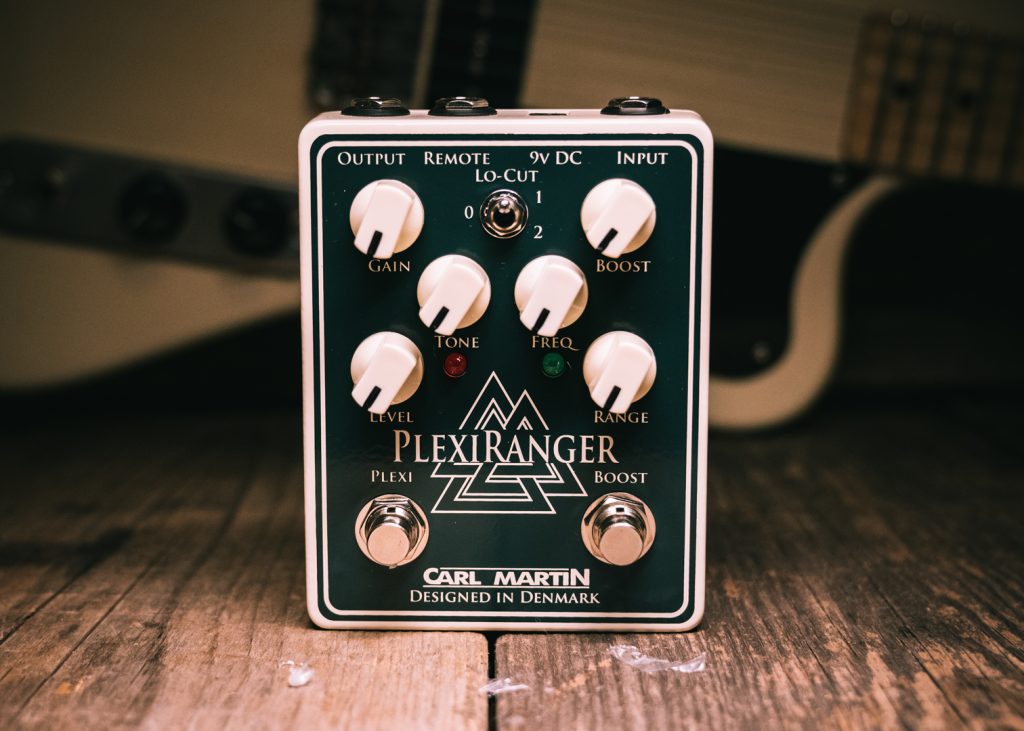
     

    Carl Martin PlexiRanger. For sale through Thomann.


    .

    .

    Throughout the years, we have had the pleasure to demo quite a few pedals from the Danish pedal company, Carl Martin.

    .

    Their latest addition to the Carl Martin effects line-up is the PlexiRanger.

    .

    V&R’s thoughts on using the PlexiRanger

    .

    “I have used the Carl Martin Plexiranger since the prototype stage,” Vintage & Rare’s Henrik says, “and I found it very versatile both soundwise and as an application in a live situation. I’ve used the PlexiTone in most of my rigs the last decade or so, so I’m very familiar with it.”

    “I used the Plexiranger as my main drive pedal on the last tour with Mike Tramp and the Band Of Brothers, both as a semi-clean driven crunchy sound, and as the overdriven rhythm and lead tone, using the remote option to switch the boost on/off from the Octaswitch (In my fly rig I use the Boss MS-3 which lets you assign the CTRL switches to make the switch when you change presets).”

    .

    “I found that using the frequency and range knobs makes a huge difference when you want to place yourself in the mix. It’s a powerful tool. For example, I might boost the signal with a compressor in front of the PlexiRanger for a particular lead sound, or I could use the PlexiRanger Boost as a ‘tone shaper’ for the more driven rhythm sounds, then when playing lead I just ad the compressor in front and delay and reverb last in the chain.”

    .

    Check out Henrik & Nicolai from V&R’s demo of the PlexiRanger.

    .

    .

    So what makes this pedal stand-out?

    .

    Well, the PlexiRanger is a two-faced pedal.

    It houses the renowned PlexiTone – an eerily accurate reproduction of the sound of a raging Marshall hunder-watter – alongside a treble booster section which you can use independently of the PlexiTone circuit.

    .

    The history of the treble booster


    Treble booster is one of those effects that most players have heard of but relatively few have on their pedalboards. Is it an EQ? Not really. Is it a fuzz? Yeah not so much. A dirty boost? Sort of but not quite. The early treble boosters were developed by companies like Dallas and Skewes as bands got louder and louder, and guitarists started to get lost amongst the low-end clutter.

    .

    Treble boosters allowed guitarists to thin out the low end, add some teeth to the high end, and – if they wanted to – to hit the amplifier’s preamp tubes with a hotter signal, driving them to distortion. It helped to carve out a place for the guitar to dominate in a band mix, and it gave players more sustain. It even helped to open up the glorious possibilities of ear-shredding feedback.


    .

    In fact, you can hear Jimmy Page talking about treble boosters in the documentary It Might Get Loud, saying; “Knowing that there was a threshold in volume, I wanted to get more sustain out of things. I’d bumped into this chap, Roger Mayer…’did I have any ideas?’ I had this record at home of a guitar that had a lot of sustain on it, and I got him to come down and have a listen to it, and I said, ‘can you get that?’. And he went away and came back with this phenomenal thing.”

    .

    Guitarists have used treble boosters to solve all sorts of musical problems. For instance, Tony Iommi’s early Black Sabbath tone was driven by a Dallas Rangemaster treble booster into his Hiwatt amplifiers, slamming the amp’s -preamp tubes and creating the fuzzy, biting, moody, doomy sound that is unmistakably Iommi.

    .

    And Jimi Hendrix’s sound guru, Roger Mayer, developed a treble booster combining silicon and germanium transistors in 1961 which was used by many of his local pals such as one Mr. Jimmy Page. 

    .

    Queen’s Brian May also used treble boosters like the classic Rangemaster to get that heavenly, harmonically excited overdrive tone out of his VOX AC30 amplifiers, while Richie Blackmore plugged his into his Marshalls for his full, expressive Stratocaster tone.

    .

    Since those glory days, amplifier design evolved to have more gain and more tone control, so there was less of a need for treble boosters. But as these things tend to go, over time, we started to hear those old tones and ask, ‘Why can’t I get that sound out of my amp?’

    .

    And that brings us to the PlexiRanger. Carl Martin looked back at those great guitar tones and how they were achieved, and thought ‘What if..?’ So the PlexiRanger combines a Plexi-voiced overdrive/distortion featuring controls for Gain, Tone, and Level; and a Rangemaster-inspired boost with controls for Boost, Range, and Frequency. There’s a three-position Lo-Cut switch (the settings are slight low-frequency cut, heavy low cut, or no low cut).

    .

    The Boost knob gives you up to 15dB of clean boost to drive your amp harder, while the Range control governs how much treble boost is applied. Then that circuit can be fed into the PlexiTone side, giving you Rangemaster-into-Plexi tones right there at your feet. And if you decide to turn off the Plexi side, you’re free to apply the boost’s magic to whatever amplifier you wish to pair it with: as we’ve seen from Iommi, May, Blackmore, and Page, treble boosters can be very amp-dependent, and the one pedal can unlock different sonic treasures from different amps. 

    .

    Written by Peter Hodgson from IheartGuitar, Henrik Berger, Nicolai Schneekloth.

    .